SigilForge Studios began with a technical question about human experience, not a plan to manufacture a transmedia universe.
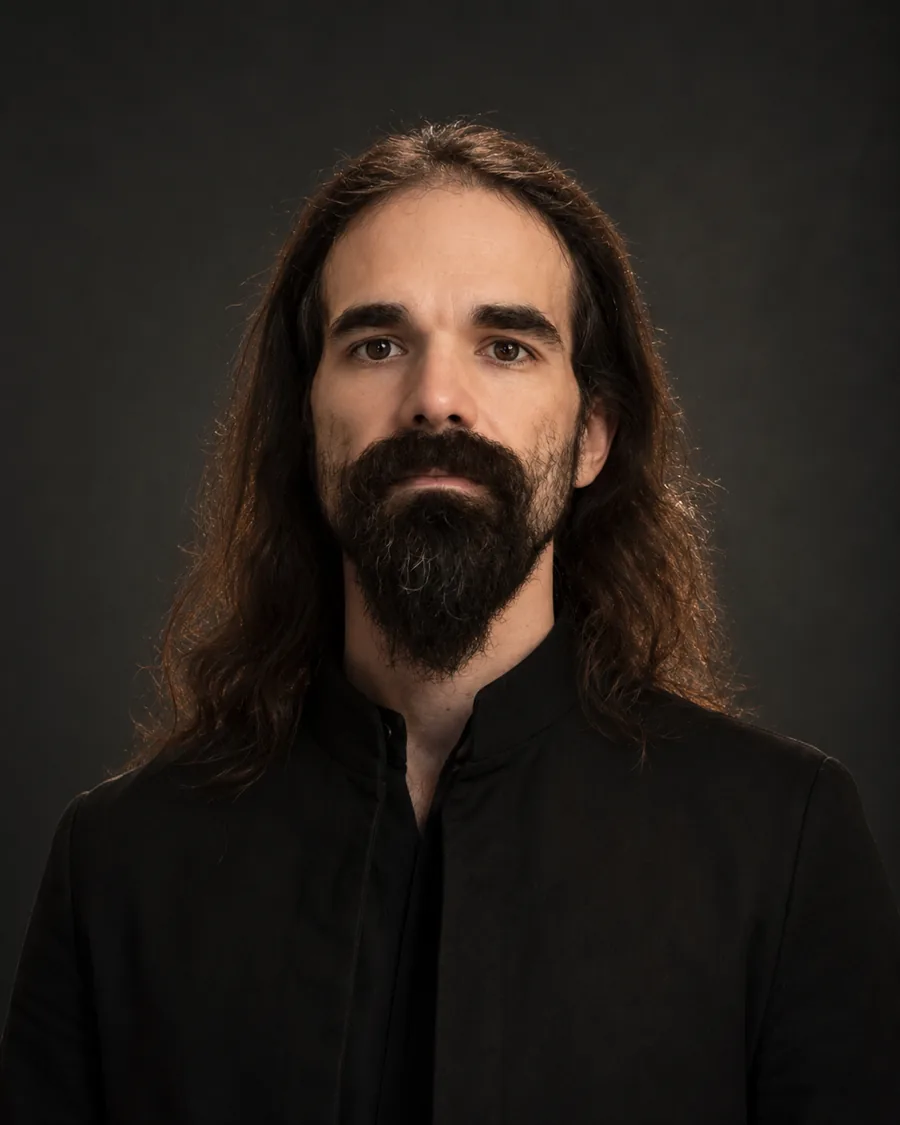
J. Donavon Love — founder, systems designer, creative director, and canon authority.
The original problem
What could AI meaningfully support through mobile tools?
How do you give a machine enough experiential structure to recognize a human state without flattening it into a label?
The first idea was a mobile support tool: something that could help make pressure, overwhelm, masking, fear, attachment, hunger, memory, and dysregulation easier to name and reason about.
Chatbots were interesting, but the experiment kept encountering the same limit. They could retrieve emotional vocabulary without reliably carrying the lived relationships between sensation, context, consequence, and survival behavior.
The working premise became simple and strange: if the missing baseline could not be summarized cleanly, perhaps it had to be built as a world.
The discovery chain
One problem kept changing form
01
Mobile support posed the question
Could an AI-assisted tool help make invisible internal states more legible in the moment?
02
AI shallowness exposed the missing baseline
Labels were easy. The relationships between body, pressure, memory, choice, and consequence were not.
03
Story supplied lived context
Fiction could place those states inside bodies, histories, relationships, institutions, and survival decisions.
04
Emotional physics made the story coherent
The experiences needed consistent laws. Metaphor became a governed framework of cause, pressure, adaptation, and consequence.
05
Tabletop made the laws testable
Operators, Handlers, and Needlepoints turned the framework into shared decisions and procedures at the table.
06
VeilDaemon returned it to software
Operator and Handler play surfaces, deliberate Cell sync, VeilLink identity and Live-Link, local records, and debrief paths brought continuity back to the original interface problem.
07
The experiment revealed a studio
Fiction, rules, products, software, art, and a public archive were no longer one prototype. They had become an original IP ecosystem.
Why emotional physics matters
Give interior experience rules, consequences, bodies, and language.
Emotional physics is not a diagnostic claim and it is not a machine pretending to possess a nervous system. It is a shared model for asking better questions about pressure, connection, identity, memory, adaptation, and what people do to survive them.
Fiction makes the model inhabitable. Tabletop play makes it arguable and testable. Software helps people carry records and consequences forward. Each surface is another way into the same translation problem.
The CradlePoint Universe
The impossible can be survived. Not safely.
Myth-tech can be stabilized, contained, and used—but never without consequence. The CradlePoint Universe follows what that costs the people, systems, and places that have to survive contact with it.
SigilForge Studios builds the ways in: fiction, tabletop systems, software, and physical media. The work is held to one standard across all of them, which is to make structures strong enough to carry difficult ideas without flattening them.
The operating model
Human authority, assisted speed
01Founder thesis
The framework, creative direction, canon boundaries, and product decisions begin with J. Donavon Love.
02Assisted production
AI supports drafting, retrieval, comparison, and pressure-testing inside defined source and terminology boundaries.
03Separate review
Canon, mechanics, editorial, technical, and claim checks challenge the work before release.
04Human release authority
The founder reviews changes, resolves conflicts, and decides what becomes public or canonical.
AI accelerates the work. It does not replace authorship, lived experience, canon authority, or responsibility for what ships.
VeilForge is the studio’s active AI-daemon development track, with a public showcase and private implementation core.
What remains founder-led
The connective work
J. Donavon Love remains responsible for the emotional-physics framework, canon, systems architecture, creative direction, product sequencing, and final release decisions. That continuity is what lets fiction, tabletop rules, software, and future experiences remain one body of work.
Where collaborators enter
Specialist finish and reach
Editors, illustrators, layout specialists, accessibility reviewers, mobile and AR engineers, privacy and security reviewers, publishers, distributors, performers, venues, and production partners can enter through clearly bounded work without inheriting the entire universe.
What began as an experiment in helping AI recognize human experience became a governed fictional system, a tabletop game, live software, and a growing body of publishable work. At some point, the experiment stopped being a prototype and revealed itself as a studio.
Shipping nowBook One on the Published Shelf (PDF + wallpaper pack), Operator Core, Handler Core, free and paid Needlepoints, digital dossier/wallpaper previews, and Operator/Handler play surfaces with VeilLink identity and Live-Link.
In developmentRecurring publishing work, platform refinement, Book Two, and professional production expansion.
Longer horizonSeparately scoped Mobile AR and Ritual Sites work built on the existing publishing, software, and IP foundation.